Bigfoot 200: Lessons in Ultra Running & High Performance
It is rare that I get the opportunity to observe one of my athletes in a high-performance situation for 45 miles. To see what is working, what needs to be adjusted, and the things you simply have to let go of and accept for what they are.
Sometimes there is nothing to fix. You just have to make the best of what you have in that moment.
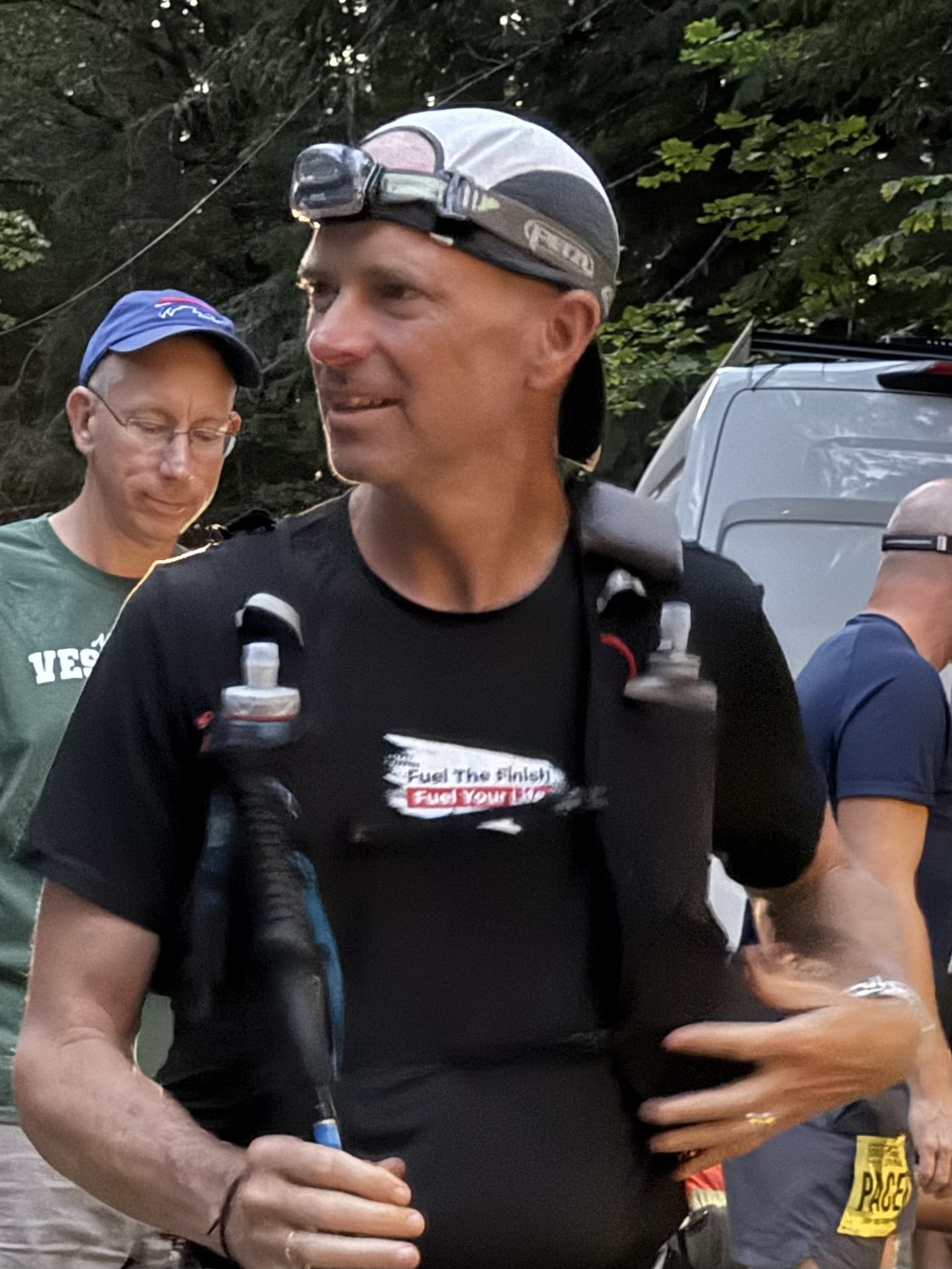
I got that opportunity this past weekend at the Bigfoot 200, a 200-mile ultramarathon through the Cascade Mountains in Washington State. I was there supporting an athlete I coach, Joe Higgs, and pacing him for 45 miles of the race. And when I say pacing, in this case I mostly mean running behind him and trying to keep up.
Joe is 55 years old, and I have coached him for more than five years.
Before the race started, his daughter read him a quote from Theodore Roosevelt's "The Man in the Arena."
“It is not the critic who counts; not the man who points out how the strong man stumbles, or where the doer of deeds could have done them better. The credit belongs to the man who is actually in the arena, whose face is marred by dust and sweat and blood; who strives valiantly; who errs, who comes short again and again, because there is no effort without error and shortcoming; but who does actually strive to do the deeds; who knows great enthusiasms, the great devotions; who spends himself in a worthy cause; who at the best knows in the end the triumph of high achievement, and who at the worst, if he fails, at least fails while daring greatly”
Listening to his daughter read those words touched me as his coach because there was a lot of history standing at that starting line with us.
Last year, Joe started the Bigfoot 200 and made it approximately 67 miles before a health emergency forced him out of the race. At the time, we didn't understand how serious it was. He would eventually end up in the hospital having heart surgery.
After he dropped from the race, Joe felt like he had disappointed me.
He couldn't have been further from the truth.
I am proud of my athletes for being willing to enter the arena. Sometimes that ends with the triumph of achieving a goal, and sometimes it ends with coming up short. I've experienced both myself. That is sport.
But there was another side to it. I felt like I had disappointed him.
As his coach, I believed it was my responsibility to guide him to the finish line. At least that was how I thought about it at the time. What I've come to understand is that my responsibility as a coach is much greater than getting an athlete across one finish line.
Neither one of us had disappointed the other.
A day after that DNF—Did Not Finish. We sat outside overlooking a lake and talked. We talked as coach and athlete, as friends, and through that strange but powerful bond that can develop between an athlete and coach after years of working toward difficult things together.
Joe told me he was coming back.
I told him I love a redemption race.
There is something special about failing at a goal, choosing to put yourself back in the arena, and going after it again. I hope everyone who participates in sport gets to experience some version of both victory and defeat because both teach you something.
That is sport. And, in many ways, that is high performance.
High performance isn't everything going perfectly. It is how you respond to pressure, discomfort, uncertainty, and everything happening around you that you cannot control.
At some point you have to ask yourself: What can I control right now? Is being negative going to help me? Or can I put that energy toward something that might help me reach the finish line?
I've come to think of high performance this way:
Do the best you can, where you are, with what you've got.
I met Joe at mile 37 to begin my 45-mile stretch with him. He was doing great, but he was frustrated with his nutrition. He knew he wasn't hitting the targets we had set, and he knew how important fueling would be if he wanted to finish the 200.
Right before we started the next leg, he threw up.
For the next 18 miles, I ran behind him and observed. I watched how he moved. I talked with him. Physically, everything looked strong. What surprised me most was his pace and how well he managed his energy by moving between running and speed walking.
His walking pace was so fast that I repeatedly had to run to catch back up to him.
At one point I remember thinking, How is he doing this?
Then I laughed to myself.
I've worked with him for so long that I had almost forgotten we had coached this.
During our first year together, we spent week after week working on energy management. I taught him to walk as fast as some people run. He practiced those workouts over and over while preparing for his first 200-miler, the Tahoe 200.
Years later, there it was.
Training showing up when he needed it.
But there was still a problem. He couldn't eat.
At the top of one of the peaks, we stopped for a break and he vomited again. At that point, the goal became simple: get him to the next aid station and get his stomach back.
He could have laid down. He could have quit right there.
But that isn't how he responded. He kept moving.
At the aid station, I communicated a protocol to the crew based on what I had learned through my own racing experience when similar symptoms landed me in a medical tent. We didn't have unlimited time to get his stomach back, but we had some time.
We adjusted.
We moved primarily to liquid calories while he was moving, with small bites of solid food when he could handle them. At aid stations, we focused on getting more solid food in and increasing sodium based on what we were seeing from him.
His stomach settled.
And that was the end of the stomach problems.
That is another part of high performance that doesn't get talked about enough. Sometimes the original plan stops working. You don't panic and you don't keep blindly forcing the same plan because that is what you wrote down before the race.
You observe. You make a decision. You adjust. Then you keep moving.
For the rest of the time I paced and crewed Joe, one thing stood out to me more than anything else: his focus.
You might think two people would talk constantly while spending that many hours together on a trail. We didn't. We talked some, but most of the time I simply ran behind him.
I watched him look at the trail in front of him.
One section at a time.
At one point, Joe had developed a bad blister that he had taped up. He asked me if I knew about the pain cave.
I told him I did.
Then he asked, "Will it work for my blister?"
I told him it would.
I tend to call it grit, and grit is something I coach. Grit is firmness of mind and spirit. It is unyielding courage and the ability to continue doing something difficult or unpleasant without giving up.
To me, it is every bit as important to endurance performance as strength, endurance training, and nutrition.
It is mindset.
Endurance athletes sometimes describe the "pain cave" as the place you enter when things get deeply uncomfortable. It is dark in there. You don't necessarily know how long you are going to be there.
But you sit in it and you work.
You trust your spirit, you trust your training, and you trust the process. Eventually you begin looking for some light on the other side.
You can fear that place and fight against it, or you can accept that discomfort is part of what you chose to do. You can meet it head-on, work through it, and sometimes discover that you are capable of a lot more than you thought.
Joe got through it.
Over the course of the race, I watched his energy move through incredible lows and highs. Late in the race, around mile 171, his energy was up. If you saw him at that moment, you might never have guessed that he had already covered 171 miles as fast as he could while surviving on little sleep. 30 minutes here, an hour there.
He honestly looked more wrecked at mile 56 than he did at mile 171.
Determination. Focus. Years of training. Being as fit and prepared as he could be. Adjusting when things went wrong. Embracing the pain cave. Doing the best he could in each moment with what he had.
That is a high-performance athlete.
Then something happened at the finish line that I don't think I'll forget.
We were waiting for Joe, knowing he wanted us to run the final lap with him. Bigfoot allows people to accompany athletes through the finish, which is different from many races where the athlete crosses the line alone.
I was standing with his son, Joey (I know a lot of Joe's), and told him, "We can run the lap with him, but he probably wants to cross the actual finish line alone."
Joey looked at me and said, "No. He's going to want us to run through it with him. I know my dad."
He was right.
When Joe came in, we joined him.
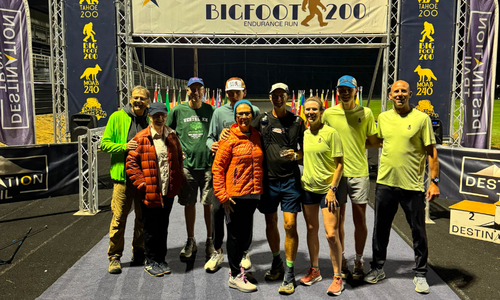
His two sons. His daughter. A longtime friend and pacer. Me, his coach and friend.
We ran with him then let him get in front of us toward the finish line.
Joe crossed and fell into his wife's arms, they kissed. Two more longtime friends were there waiting for him.
I stood there looking at all of them and realized how fitting it was.
This was an individual achievement with an entire team behind it.
These were people who had been with him through different parts of his life. People who had seen victories, struggles, triumphs and defeats. People who had supported him through last year's DNF, the health scare that followed, the heart surgery, the decision to come back, another year of training, and finally another starting line.
And now they were there as Joe became a three-time 200-mile ultramarathon finisher.
That is high performance too.
We like to celebrate the athlete crossing the finish line, and we should. But very few meaningful achievements are accomplished completely alone.
There is usually a team somewhere behind them.
Family. Friends. Training partners. Crew. Pacers. Coaches. People who believed when things were going well and people who stayed when they weren't.
High performance isn't a single destination. It is a journey made up of many destinations, failures, adjustments, lessons, people, and eventually, if you keep going, some incredible finish lines.
Joe didn't just finish Bigfoot this year.
He exceeded the goal we had set and finished about an hour faster than we expected.
Afterward, I asked him a simple question.
"What did it take?"
After everything that had happened over those 200 miles and everything that had happened over the previous year his answer wasn't about pace, fitness, nutrition, training volume, or strategy.
He said:
"Hope and believing I could do it."
Stay Built to Endure,
Coach Joe Beckerley
Fuel The Finish